Explainer
How Cold Is Too Cold for Chickens? What the Sources Actually State
No university extension service read for this site names a temperature at which adult chickens come to harm. The only figure in these sources is the University of Minnesota's 35 °F, measured inside the coop, as the point to consider heat. What the sources give instead are conditions: cold becomes a problem together with wind and moisture, and the birds show it by huddling, fluffing up and standing on one foot.
Disclosure: This page contains paid links to Amazon, marked with * or “paid link”. If you buy through them, we earn a commission at no extra cost to you. As an Amazon Associate I earn from qualifying purchases. This site is financed by these commissions; products are selected by the criteria on our methodology page. How we evaluate · Learn more
The short version
There is no sourced cut-off temperature. Ohio State University Extension writes that most breeds handle cold, even below freezing, and that problems arise when cold meets wind and moisture. The University of Minnesota Extension names 35 °F inside the coop as the point to add heat. Too cold is when birds huddle, keep fluffing their feathers and lift a foot, or when combs show frostbite.
Jump to a section
- Why there is no single number
- The one figure that exists: 35 °F inside the coop
- What turns cold into a problem
- Signs that your chickens are too cold
- Frostbite: the damage cold actually does
- Night, snow and the run
- Water freezes long before chickens are in trouble
- If the coop is right and the birds are still cold
 AI-generated
Why there is no single number
Search for a temperature limit and you will find plenty: zero, ten below, twenty below. We went through the winter publications of five university extension services looking for the source of these figures and found none. Not one of them states a temperature that adult chickens can or cannot take.
That is not an oversight. The same thermometer reading means very different things for a dry Wyandotte on a sheltered roost and for a wet bantam in a draft. The extension services therefore describe conditions and signs instead of a limit. Which breeds the sources name as hardy is covered under cold-hardy chicken breeds.
| Source | What it states about cold |
|---|---|
| Ohio State University Extension | Most breeds handle cold, even temperatures below freezing. Problems arise when cold is combined with wind and moisture. Birds should acclimate as winter approaches. |
| University of New Hampshire Extension | Chickens are fairly cold-hardy thanks to their down layer. Larger breeds are generally the hardiest. |
| University of Maryland Extension | Adult birds protected from wind and wet weather should not need additional heat. Bantams and molting hens are exceptions. |
| University of Minnesota Extension | Recommends supplemental heat when the temperature inside the coop falls below 35 °F. Describes signs of cold stress. |
| University of Wisconsin–Madison Extension | Gives no temperature. A large flock produces enough body heat for its coop, a small one usually does not. |
The one figure that exists: 35 °F inside the coop
According to the University of Minnesota Extension, heat is advisable once the temperature inside the coop drops below 35 °F. The reading is taken at the height of the nest boxes or the lower roost. Two things follow from that:
- It is not an outdoor temperature. The forecast low and the reading at the roost are two different numbers.
- It is a point to consider heat, not a point of harm. Three other extension services advise against heating protected adult birds at all. The full comparison is on do chickens need heat in the winter.
So when someone asks whether 20 °F or 10 °F is too cold, the sourced answer is a question back: how dry and how sheltered is the coop, and what kind of birds are in it?
What turns cold into a problem
The sources name the same handful of factors again and again.
| Factor | Why it matters | Source |
|---|---|---|
| Moisture | Damp air feels colder than dry air. High moisture together with cold is named as the main cause of frostbite. | Maryland; Minnesota |
| Wind and drafts | Air blowing directly on birds chills them. Cold drafts strip away the warmth held in the feathers. | Maryland; New Hampshire |
| Body size | Bantams produce less body heat than large fowl. Larger breeds are generally the hardiest. | Maryland; New Hampshire |
| Feathering | Molting hens may need extra heat or protection. Loose-feathered birds may insulate better than tightly feathered ones. | Maryland; Wisconsin |
| Comb size | Large combs and wattles are prone to frostbite, even on hardy breeds and especially on roosters. | Maryland; Ohio State |
| Flock size | Few birds produce little shared warmth. | Wisconsin |
| Acclimation | Birds build tolerance when temperatures fall gradually. | Ohio State |
Ohio State lists breeds it regards as cold-tolerant, among them Brahmas, Cochins, Buff Orpingtons, Plymouth Rocks, Rhode Island Reds, Wyandottes, Black Australorps and Dominiques. Maryland names Leghorns, Minorcas and other Mediterranean breeds as prone to frostbite because of their large combs.
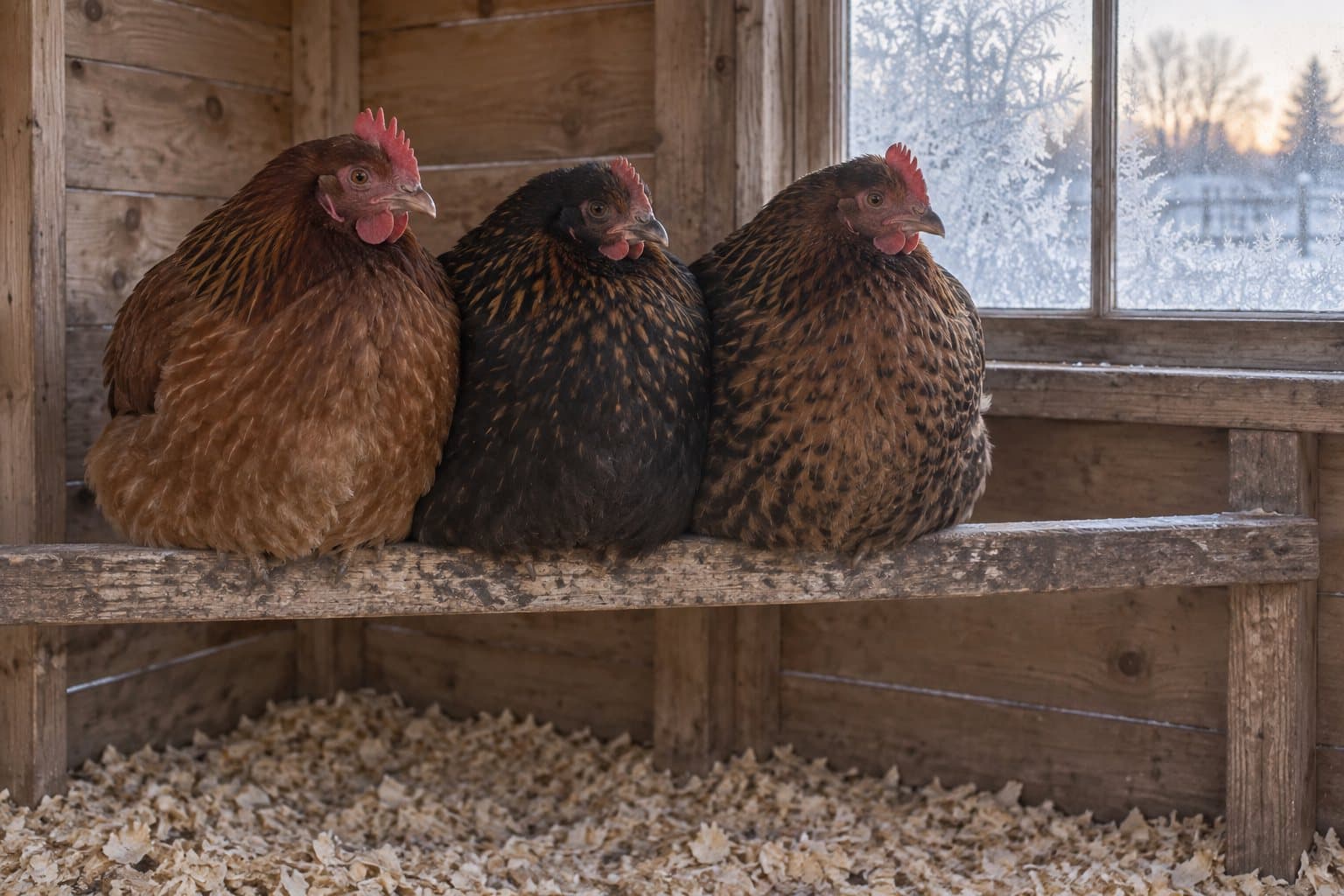 AI-generated
Signs that your chickens are too cold
Since there is no number, the birds are the gauge. The University of New Hampshire Extension lists three signs that chickens are too cold, and the University of Minnesota Extension describes the same behavior as cold stress:
- they huddle together,
- they lift a foot and stand on one leg,
- they fluff their feathers frequently.
New Hampshire's advice for that case comes without a heater: check the coop for drafts or too much airflow, add bedding, and make sure feed and fresh water are plentiful. It notes that chickens may eat up to 25 percent more in cold weather.
Frostbite: the damage cold actually does
The harm the sources describe is frostbite on combs, wattles and feet, not birds freezing on the roost. Ohio State describes gray, black or brittle areas as the signs.
The cause is not cold alone. According to the University of Minnesota Extension, high moisture together with cold is the main cause. Chickens put a lot of water into the coop air: Wisconsin notes that they drink roughly two pounds of water for every pound of feed and pass much of it in moist droppings. Without a way out, that moisture settles on combs and freezes.
What the sources recommend:
- Ventilate above the birds. A vent or opening near the roof lets moist air out (Maryland). Ohio State warns that tarps or plastic on the sides of a run should not reach all the way to the roofline.
- Wooden roosts off the floor. Wood does not carry cold to the feet the way metal or plastic pipe does (Maryland, New Hampshire). Ohio State asks that every bird can roost off the floor at night.
- Keep snow out of the run where you can (Ohio State).
- Petroleum jelly on combs and wattles. Maryland and New Hampshire list it for the coldest days. According to the University of Minnesota Extension it may help to prevent frostbite and is not a treatment.
If you suspect frostbite, New Hampshire's advice is short: consult a veterinarian. Ohio State warns against warming an affected area quickly and also points to a veterinarian when infection is suspected. This site gives no treatment advice.
Night, snow and the run
At night the flock sits still, close together, with feet covered by feathers. That is when the roost has to be right: wide enough to sit on flat-footed, made of wood, below the vents and out of the draft. New Hampshire gives 9 to 12 inches of roost space per bird, Ohio State at least 6 to 8 inches.
Outside, wind and wet decide. None of the sources sets an outdoor limit for letting birds into the run. A wind break, a dry floor and a cleared patch of ground make the run usable on days when open snow is not.
Water freezes long before chickens are in trouble
There is one hard limit in winter, and it is not the birds' tolerance. Water freezes at 32 °F, and Maryland points out that chickens cannot break through ice to drink. Ohio State recommends changing water twice a day in winter and more often on colder days. For most flocks the first winter purchase is therefore a way to keep water liquid, not a heater. The options are laid out under heated chicken waterers, and the routine with and without power under how to keep chicken water from freezing.
If the coop is right and the birds are still cold
Bantams, molting hens and very small flocks are the cases in which the sources allow for extra help. If you decide to add heat, a low-wattage radiant panel near the roost warms the birds next to it rather than the whole coop. It is the lower-risk option compared with a heat lamp, not a risk-free one, and it needs a fixed outlet: the NFPA tip sheet for backyard coops says not to use extension cords in the coop. Which devices fit that description is covered in the safest heater for a chicken coop, and the supply side under power for the coop.
How birds keep themselves warm in the first place is explained under do chickens get cold. What to do about pale or blackened comb tips is on the page about chicken frostbite, and the target-temperature question has a short answer of its own: what temperature should a chicken coop be in winter. An overview of heaters, waterers and the questions around them is on the chicken coop heater home page.
Questions keepers ask
What temperature is too cold for chickens at night?
No extension service read for this site gives a night-time limit. The only number is the University of Minnesota's: consider heat when the temperature inside the coop, at the height of the nest boxes or the lower roost, falls below 35 °F. At night the birds sit together on the roost, so a dry coop without drafts at roost height matters more than the outdoor reading.
Is 10 degrees too cold for chickens?
The sources do not answer with a yes or no for any single temperature. Ohio State University Extension says most breeds handle cold, even below freezing, and that problems come with wind and moisture. At 10 °F outside, check three things: whether the coop is dry and draft-free, whether the water is liquid, and whether the birds show signs of cold stress such as huddling or lifting a foot.
How cold can chickens survive?
No primary source read for this site names a lethal temperature, so any figure you find elsewhere is unsourced. What the extension services describe is a set of conditions. Large, fully feathered, acclimated birds in a dry, draft-free coop are the hardiest. Bantams, molting hens, wet birds and birds in a draft are at risk much earlier.
How cold is too cold for chickens to be outside?
None of the sources sets an outdoor limit. Ohio State University Extension recommends clearing snow from the run, which keeps feet off ice and snow. Wind and wet are the conditions to avoid, so a run with a wind break and a dry floor is usable on days when an open, snow-covered run is not. Watch for birds that lift a foot.
How can you tell if chickens are too cold?
The University of New Hampshire Extension lists three signs: birds huddle together, lift a foot off the ground and fluff their feathers frequently. The University of Minnesota Extension describes the same behavior as cold stress. If you see it, check the coop for drafts, add dry bedding and make sure feed and liquid water are available. A bird that is weak or injured belongs with a veterinarian.
Sources we read
- Ohio State University Extension: Winter and Your Backyard Chickens (ANR-66)
- University of New Hampshire Extension: How should I take care of backyard chickens in winter?
- University of Maryland Extension: Winter Weather and Small Flocks (FS-1133)
- University of Minnesota Extension: Caring for chickens in cold weather
- University of Wisconsin–Madison Extension: Preparing for Winter
Keep reading
- ExplainerDo chickens need heat?Do chickens need heat in the winter? Three extension services advise against it, one names 35 °F inside the coop, two say it depends. The sources side by side.
- Buying guideSafest coop heaterNo coop heater is risk-free. Which type carries the lowest documented risk, what the NFPA and extension services ask for, and which panel documents the most.
- OverviewHeated chicken waterersHeated chicken waterers explained: fountains, nipple drinkers and add-on heaters, 60 to 125 watts, rated temperatures per manufacturer and what none of them do.
- How-toKeep water from freezingHow to keep chicken water from freezing: heated waterers and bases with power, rubber tubs, swapping and insulation without. Methods sorted by daily effort.
- ExplainerPower for the coopThe NFPA says not to use extension cords in the coop. What a sound power supply for heaters and heated waterers looks like, and where manuals disagree.
Who is behind this page
chickencoopheater.com Editorial Team
Coop heat, winter water and the sources behind both
We are the editorial team at chickencoopheater.com. We read what university extension services, the NFPA and manufacturers publish about heating a coop and keeping water liquid, and turn it into plain-English buying advice with the sources on every page.
- Extension and fire-safety sources named
- Manufacturer data and manuals compared
- Disagreements between sources shown
- Compared by manufacturer data