Buying guide
Radiant Panel Heaters for Chicken Coops: 140 to 200 Watt Flat Panels Explained
A radiant heater for a chicken coop is a closed flat panel of roughly 140 to 200 watts that warms the birds sitting next to it by infrared radiation. It does not heat the air of the coop, and it is not meant to. Among the panels with manufacturer-documented data, the 150-watt Cozy Products Cozy Coop is our pick.
Disclosure: This page contains paid links to Amazon, marked with * or “paid link”. If you buy through them, we earn a commission at no extra cost to you. As an Amazon Associate I earn from qualifying purchases. This site is financed by these commissions; products are selected by the criteria on our methodology page. How we evaluate · Learn more
The short version
A radiant panel heater warms the hens beside it, not the coop air. Coop panels draw about 140 to 200 watts, against the 250 watts of a typical heat lamp bulb, and have no exposed bulb. Our pick is the 150-watt Cozy Coop with an ETL listing stated by the manufacturer. Panels with a built-in temperature sensor, timer or app exist as marketplace listings with seller-only data.
How a radiant panel heats
A fan heater warms air and blows it around. A radiant panel does something else. Its surface gives off infrared radiation, and that radiation turns into warmth where it lands: on feathers, on the roost, on the wall opposite. The University of Minnesota Extension describes radiant heaters as warming the birds, not the air. Sweeter Heater, which builds an overhead radiant heater, calls its product a specific-area heater designed to heat the object under it.
Two things follow. A panel only helps birds that sit within its reach, so its position matters more than its wattage. And the coop stays cold. That is intended. A professor of the University of Maine Cooperative Extension describes the type in the Bangor Daily News: such heaters radiate low-temperature heat and are mounted on the walls, so the chickens can go toward them if they want.
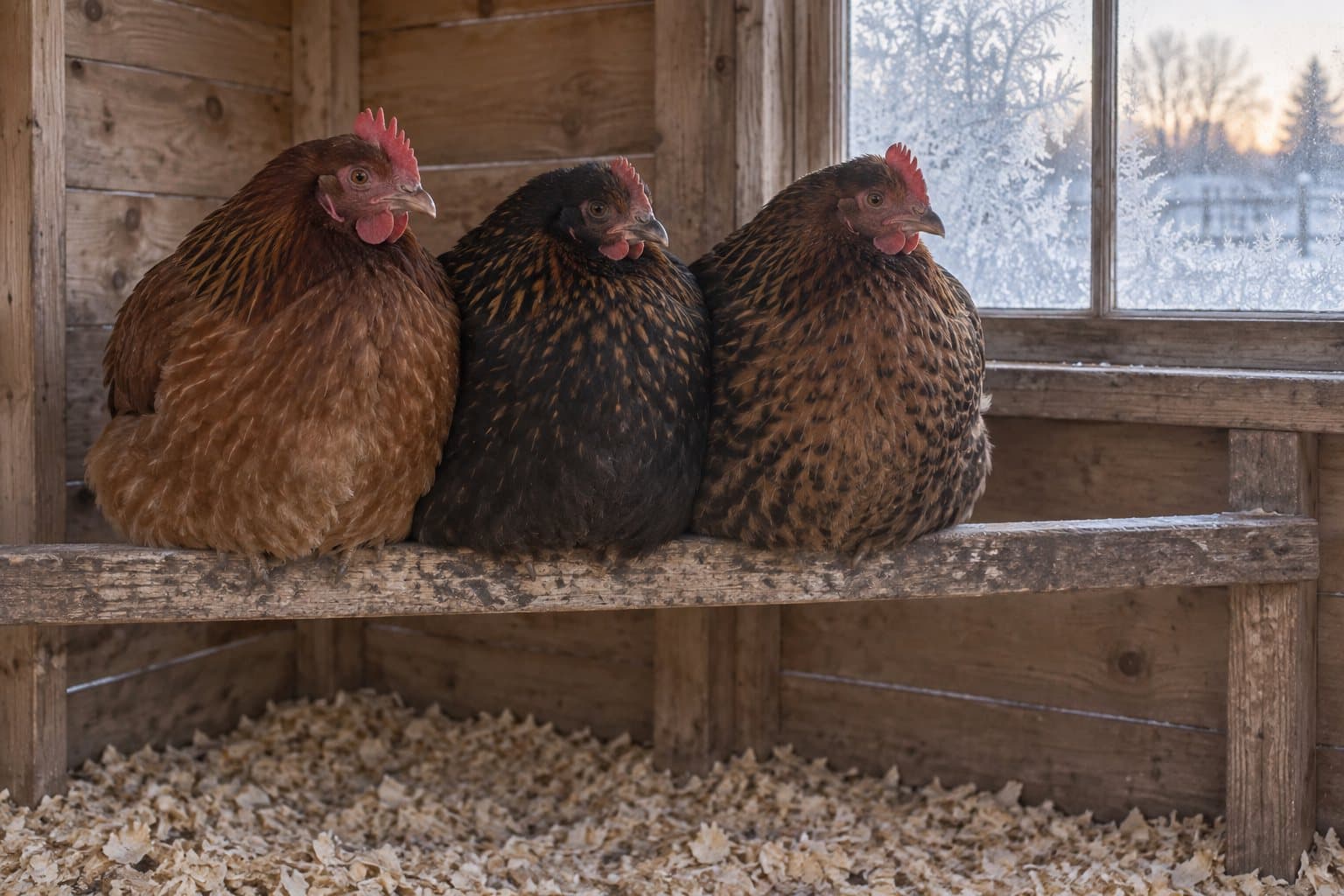 AI-generated
Whether a flock needs that offer at all is a separate question with two camps among the extension services. It is answered under do chickens need heat in the winter.
Cozy Products
Cozy Coop 150 W panel
A 150-watt flat radiant panel from an established brand that warms the birds next to it instead of the whole coop.
Why here: A 150 W flat panel for the wall or the included feet, with wattage, dimensions and an ETL listing for zero clearance stated on the manufacturer's own product page.
Best for: Keepers who have decided to add gentle heat near the roost and want a panel with a manufacturer-documented listing mark.
What speaks for it
- ETL-listed for zero clearance, according to the manufacturer
- Mounts on a wall through keyhole slots or stands on the included feet
- 150 W, against the 250 W of a typical heat lamp bulb
- Cord is coil-shielded, per manufacturer
What to know first
- No thermostat: a cord switch sets half or full power (instruction sheet), so it runs whenever it is switched on unless you add a thermostat outlet
- The instruction sheet says “household use only” and dry areas only, while the NFPA asks for equipment made for agricultural or commercial use
- 6 ft cord: needs a fixed outlet close by, because extension cords do not belong in a coop (NFPA)
- Warms only birds within reach of the panel, not the coop air
- Still a heat source next to bedding and dust: lower risk than a lamp, not risk-free
- Type
- Flat radiant panel
- Power
- 150 W, 120 V
- Size
- 19 × 8 × 1 in (wall mount)
- Thermostat
- none; cord switch for half or full power, over-temperature regulator (instruction sheet)
- Mounting
- Wall or free-standing
- Listing mark
- ETL, zero clearance (manufacturer)
- Cord
- 6 ft
- Weight
- 3.2 lb
Panel, overhead heater or heat lamp?
“Radiant heater” and “infrared heater” are used for three different devices.
| Device | Power | Position | Bulb |
|---|---|---|---|
| Flat radiant panel | about 140 to 200 W | On the wall next to the roost, or free-standing | No |
| Overhead radiant heater | 150 W for the Sweeter Heater 11 × 40 (manufacturer) | Hung above the roost | No |
| Heat lamp | bulbs of typically 250 W | Hung or clamped | Yes |
The first two are closed heaters. The third is a hot bulb in a fixture, and it is the one that fire guidance warns about. The details are on heat lamp in a chicken coop. The overhead heater is covered in the comparison of the best chicken coop heaters.
Two panels with manufacturer data
This selection covers only products sold on Amazon. It is not a market overview. Products are compared by manufacturer and listing data, not by hands-on testing. How we evaluate
| Comparison | Our pick for coop heatCozy Coop 150 W panel | Budget panelPetNF PF093, 140 W panel |
|---|---|---|
| Type | Flat radiant panel | Flat radiant panel |
| Power | 150 W, 120 V | 140 W, adjustable |
| Capacity / size | 19 × 8 × 1 in (wall mount) | – |
| Temperature control | none; cord switch for half or full power, over-temperature regulator (instruction sheet) | none; rotary power control |
| Mounting / use | Wall or free-standing | Floor stand or wall |
| Safety data | ETL, zero clearance (manufacturer) | none stated |
| Price class | mid-range | budget |
| Best for | Keepers who have decided to add gentle heat near the roost and want a panel with a manufacturer-documented listing mark. | Small coops where a low-cost panel near the roost is enough. |
| On Amazon(paid link to Amazon, opens in a new tab)Ad · paid link · price and delivery shown on Amazon | On Amazon(paid link to Amazon, opens in a new tab)Ad · paid link · price and delivery shown on Amazon |
- Our pick for coop heatCozy Coop 150 W panel
- Type
- Flat radiant panel
- Power
- 150 W, 120 V
- Capacity / size
- 19 × 8 × 1 in (wall mount)
- Temperature control
- none; cord switch for half or full power, over-temperature regulator (instruction sheet)
- Mounting / use
- Wall or free-standing
- Safety data
- ETL, zero clearance (manufacturer)
- Price class
- mid-range
- Best for
- Keepers who have decided to add gentle heat near the roost and want a panel with a manufacturer-documented listing mark.
On Amazon(paid link to Amazon, opens in a new tab)Ad · paid link · price and delivery shown on Amazon - Budget panelPetNF PF093, 140 W panel
- Type
- Flat radiant panel
- Power
- 140 W, adjustable
- Capacity / size
- –
- Temperature control
- none; rotary power control
- Mounting / use
- Floor stand or wall
- Safety data
- none stated
- Price class
- budget
- Best for
- Small coops where a low-cost panel near the roost is enough.
On Amazon(paid link to Amazon, opens in a new tab)Ad · paid link · price and delivery shown on Amazon
Cozy Products Cozy Coop, 150 W
According to the manufacturer, the Cozy Coop measures 19 by 8 inches, is 1 inch deep on the wall and 5 inches deep on its feet, weighs 3.2 pounds and draws 150 watts at 120 volts. It hangs on keyhole slots. The product page states an ETL listing with zero-clearance certification and a coil-shielded cord of 6 feet. The manufacturer now sells it under the name “Cozy Chickens” heating panel.
The instruction sheet adds a cord switch for half or full power and an over-temperature regulator. Neither is a thermostat: plugged in and switched on, the Cozy Coop* (paid link) heats continuously, so a thermostat outlet in front of it is the sensible addition. The short cord fixes where the outlet has to be. The sheet also says “household use only,” dry areas only, and gives a six-month warranty; the details are on the Cozy Coop heater page.
PetNF PF093, 140 W
The PetNF panel is the low-cost alternative with manufacturer data. It draws 140 watts and has a rotary control that adjusts the power. According to the manufacturer it stands upright on the floor or mounts on a wall. The control is not a thermostat, so it does not react to the temperature in the coop. The product page names no listing mark. Check the device itself for one before you mount the PetNF panel* (paid link).
Four panels with seller-only data
Most flat panels in our research come from marketplace brands that have no website and no manual to download. Their data is stated in the listing and nowhere else that we could read. Such listings often change from one season to the next. The Farm Innovators panel is a different case: the brand is long established, but the panel was not on the product list of the manufacturer's website when we checked in October 2026, so its data also comes from the listing.
Because none of these figures is confirmed, the four are listed as plain links, not in a comparison table, and none of them is a pick: the 200 W panel with temperature sensor* (paid link), the 200 W panel with timer* (paid link), the foldable 180 W panel* (paid link) and the Farm Innovators 200 W panel* (paid link).
- 200 W panel with temperature sensor. According to the seller it switches itself by a built-in sensor. That is the feature the Cozy Coop lacks.
- 200 W panel with timer. Adjustable temperature and a timer, according to the seller, for example for the coldest hours before dawn.
- Foldable 180 W panel, 30 × 12 in. The largest surface here according to the seller, with app control, timer and adjustable temperature. App control is one more thing that can fail in an unheated outbuilding.
- Farm Innovators 2-in-1, 200 W. Wall-mounted or free-standing. No thermostat is named in the product title.
None of the four has a listing mark that we could confirm, and none is a pick. They are alternatives for readers who want a built-in control and accept that the figures are the seller's.
What to look for in a panel
Surface size and position before watts. No primary source sizes a coop heater by floor area or volume. A panel warms what is in front of it. A compact panel covers a short stretch of roost. A long roost is the case for a longer panel.
A control that switches by temperature. A panel without a thermostat runs day and night. Either the panel brings a sensor, which among the panels here is only stated by sellers, or a plug-in thermostat outlet does the job. Both routes are compared under chicken coop heaters with a thermostat.
Farm Innovators
Thermo Cube TC-3
A plug-in outlet that switches a heater or heated base by the surrounding air temperature, so it does not run on mild days.
Why here: A plug-in outlet that switches a panel by the surrounding air temperature. The manufacturer names 35 °F for the home and farm version and 0 °F and 20 °F for automotive versions, so check the version on the listing.
Best for: Any panel or heated base that has no thermostat of its own.
What speaks for it
- Works with any 15 A, 120 V electric heater (manufacturer)
- Plugs directly into a standard outlet
- Turns a plain heater into a temperature-switched one
What to know first
- Sold in several versions (TC-1, TC-2, TC-3, TC-21): the manufacturer names 35 °F for home and farm use and 0 °F and 20 °F for automotive use – check the version on the listing
- The manufacturer's page names no switch-off temperature; “on at 35 °F, off at 45 °F” is a seller statement
- Switches by the air temperature where it is plugged in, not by the water or the roost
- Needs a fixed, GFCI-protected outlet like every device in the coop
- Type
- Thermostat outlet
- Power
- up to 15 A at 120 V
- Control
- switches by ambient air temperature; 35 °F version for home and farm use (manufacturer); switch-off temperature not stated
- Use
- Plugs into a fixed outlet
- Price class
- budget
A listing mark stated by the manufacturer. It shows that a testing laboratory examined the design. What the mark means for safety, and what it does not, is discussed under the safest heater for a chicken coop.
Cord length. The NFPA tip sheet rules out extension cords in the coop. The cord of the panel therefore decides where the fixed outlet has to be. More on that under power for the coop.
Mounting a panel
Pick the wall next to the roost
The panel should face the birds where they sleep. The University of Minnesota Extension refers to the height of the nest boxes or the lower roost when it measures coop temperature.Mount it off the floor
Wall mounting keeps the panel out of the bedding. The NFPA tip sheet asks that heaters be kept away from anything that can burn.Leave the birds a choice
Birds should be able to move toward the panel and away from it.Route the cord out of reach
Ohio State University Extension asks that the electrical feed be sturdy, safe and not accessible to the chickens.Follow the manual and clean regularly
Clearances are the manufacturer's to state. Brush dust and cobwebs from the panel, as the NFPA tip sheet asks for fixtures and outlets.
Running cost of a panel
A 150-watt panel that runs for 14 hours uses 2.1 kilowatt-hours; a 140-watt panel uses a little less and a 200-watt panel more. Multiply by the rate on your own electricity bill to get the cost per night. A thermostat lowers the figure, because the panel then pauses on milder nights. Why more watts do not make a warmer coop is explained under what size heater for a chicken coop.
What a radiant panel costs per night
- Energy per day
- 2.1 kWh
- per day
- –
- per 30 days
- –
Formula: watts × hours ÷ 1,000 × your price per kilowatt-hour. This is an upper bound: it assumes the device draws full power for every hour entered. A device with a thermostat runs less. Enter the rate from your own electricity bill; there is no preset. For orientation only, a dated example: 18.31 cents per kWh was the U.S. average residential price for July 2026 (EIA, Electric Power Monthly, Table 5.6.A).
Limits of a radiant panel
A panel is lower-risk than a lamp, not risk-free. Cozy Products advertises its panel as “designed for greater safety” than heat lamps. The University of New Hampshire Extension still judges the fire risk of a heat source next to combustible bedding as too high in most circumstances. A panel needs fixed mounting, a fixed outlet with ground-fault protection and regular removal of dust. The two devices are compared point by point under radiant panel vs heat lamp, and the mounting steps are under how to install a chicken coop heater.
It also does not replace the basics. Every extension service we read puts a dry, draft-free, ventilated coop before any heater. And a panel does nothing for the water, which freezes a few feet away from it. That side starts at heated chicken waterers.
Which panel?
Which one for which coop?
If you want a panel with manufacturer-documented data and a listing mark → Cozy Coop 150 W panel
View(paid link to Amazon, opens in a new tab)Ad · paid link · price and delivery shown on AmazonIf the coop is small and the price class decides → PetNF PF093, 140 W panel
View(paid link to Amazon, opens in a new tab)Ad · paid link · price and delivery shown on AmazonIf you want to see all heater types first
Winter coop finder
Question 1 of 3
This selection covers only products sold on Amazon. It is not a market overview. Products are compared by manufacturer and listing data, not by hands-on testing. How we evaluate
What do you want to sort out first?
Liquid water is needed every day. Extra heat is optional for most adult flocks.
Questions keepers ask
What is a radiant panel heater for a chicken coop?
It is a closed, flat electric heater that gives off infrared radiation from its surface. The radiation warms the bodies in front of it, in this case the hens on the roost, and hardly changes the air temperature of the coop. Coop panels are rated at roughly 140 to 200 watts. Flat panel heater, radiant heat panel and infrared panel are names for the same type of device.
Will a radiant panel heat the whole chicken coop?
No, and it is not built for that. The University of Minnesota Extension describes radiant heaters as warming the birds rather than the air. Sweeter Heater states for its overhead radiant heater that it is not designed to heat the entire coop. A thermometer on the far wall will show little change. The birds decide how close they sit.
Is an infrared heater the same as a heat lamp?
Both give off infrared radiation, but they are different devices. A heat lamp is a bulb of typically 250 watts in a fixture. A radiant panel is a closed flat heater with no bulb and a lower power draw. The NFPA tip sheet asks that heat lamps be properly secured and kept away from anything that can burn, and the Maine Fire Marshal's Office names heat lamps first among the top causes of coop fires.
How many watts should a radiant heater for a chicken coop have?
No primary source gives a rule by coop size, and we do not invent one. The panels sold for coops draw 140 to 200 watts. Because a panel warms the birds next to it, a longer roost is better served by a longer panel or a second position than by more watts in one spot. More watts raise the running cost in direct proportion.
Can a radiant panel stand on the floor of the coop?
Several panels are sold with feet for free-standing use, the Cozy Coop among them. The floor is where the bedding is, and the NFPA tip sheet asks that heaters be kept away from anything that can burn and placed so they cannot be knocked over. Wall mounting at roost height keeps the panel clear of bedding and out of the way of scratching birds.
Sources we read
- University of Minnesota Extension: Caring for chickens in cold weather
- Cozy Products: Cozy Chickens chicken coop heating panel, product page
- PetNF: PF093 chicken coop heater, product page
- Sweeter Heater: FAQ
- Bangor Daily News: heat lamps and coop fires, with University of Maine Cooperative Extension and the Maine Fire Marshal's Office
- NFPA safety tip sheet: Backyard Chicken Coop Safety (copy published by the City of Kinston, NC)
- Cozy Products: Instructions for the Cozy Chickens Chicken Coop Heating Panel (PDF)
- Farm Innovators: Thermo Cube thermostatically controlled outlet, product page
Keep reading
- Buying guideBest coop heatersEight chicken coop heaters compared by documented data: wattage, listing mark, thermostat, mounting. With open criteria and one clear pick.
- Buying guideSafest coop heaterNo coop heater is risk-free. Which type carries the lowest documented risk, what the NFPA and extension services ask for, and which panel documents the most.
- ComparisonHeat lamp in the coopHeat lamps are named first among the top causes of coop fires. What the NFPA and extension services say, the rules if you use one, and the radiant panel instead.
- ExplainerPower for the coopThe NFPA says not to use extension cords in the coop. What a sound power supply for heaters and heated waterers looks like, and where manuals disagree.
- ExplainerDo chickens need heat?Do chickens need heat in the winter? Three extension services advise against it, one names 35 °F inside the coop, two say it depends. The sources side by side.
- Buying guideSolar coop heatersA 150-watt coop heater needs 2.1 kWh per night; a 12 V, 100 Ah battery holds a nominal 1.2 kWh. The solar math, what the 30-watt units deliver, and what helps.
Who is behind this page
chickencoopheater.com Editorial Team
Coop heat, winter water and the sources behind both
We are the editorial team at chickencoopheater.com. We read what university extension services, the NFPA and manufacturers publish about heating a coop and keeping water liquid, and turn it into plain-English buying advice with the sources on every page.
- Extension and fire-safety sources named
- Manufacturer data and manuals compared
- Disagreements between sources shown
- Compared by manufacturer data