Explainer
Do Chickens Need Heat in Winter? What Six Extension Services Say
Often not, but the sources disagree. Three university extension services advise against supplemental heat for adult chickens that are protected from wind and wet, one recommends heat once the temperature inside the coop falls below 35 °F, and two say it depends on the flock. All six put a dry, draft-free, ventilated coop first.
Disclosure: This page contains paid links to Amazon, marked with * or “paid link”. If you buy through them, we earn a commission at no extra cost to you. As an Amazon Associate I earn from qualifying purchases. This site is financed by these commissions; products are selected by the criteria on our methodology page. How we evaluate · Learn more
The short version
Adult, healthy chickens in a dry, draft-free, ventilated coop often get through winter without a heater. Maryland, New Hampshire and Maine extension advise against supplemental heat. The University of Minnesota Extension recommends it once the temperature inside the coop drops below 35 °F. Wisconsin and Ohio State say it depends on flock size, breed and housing. Bantams and molting hens are the named exceptions.
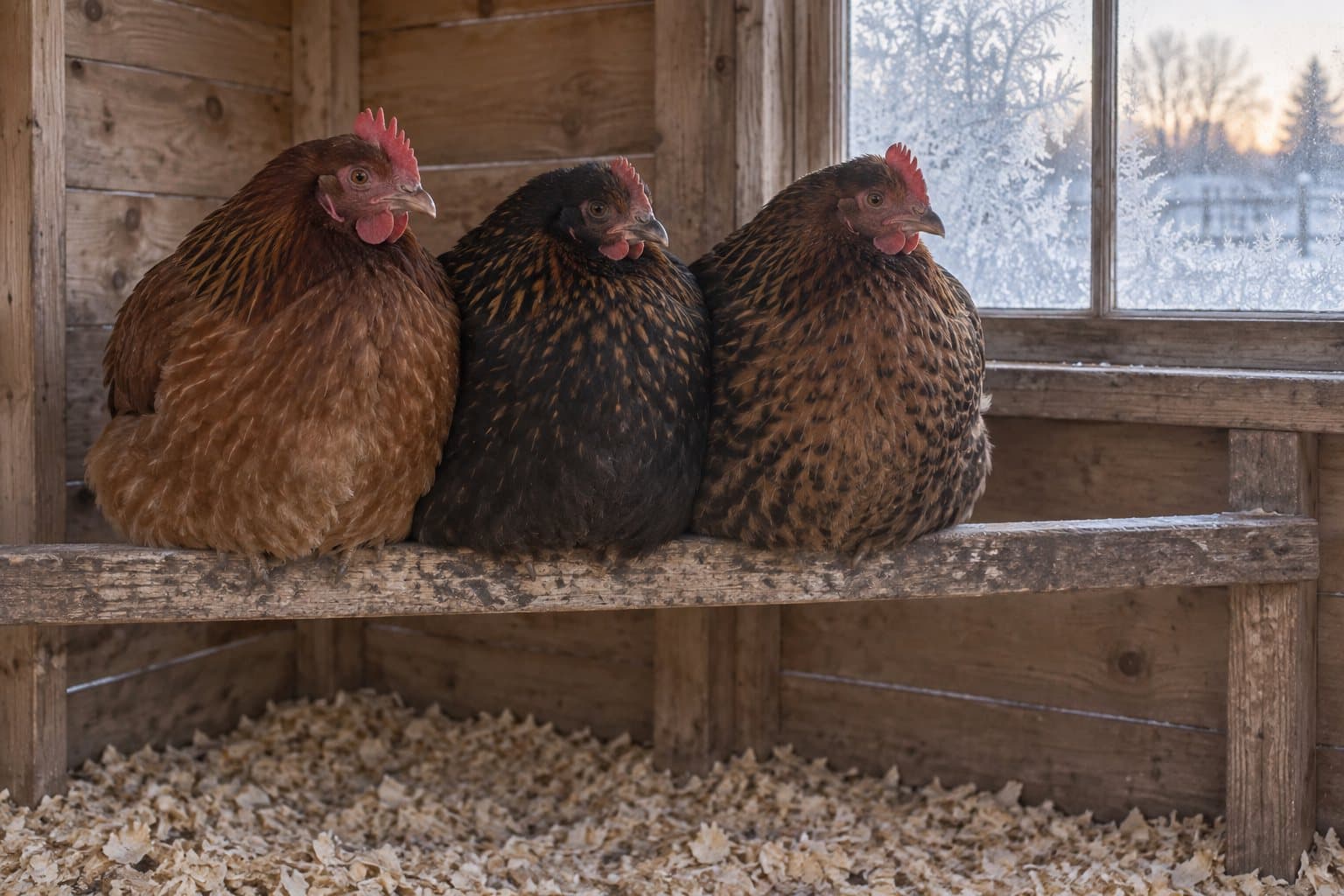 AI-generated
The short version: two camps, one shared starting point
Most guides answer this question with a single rule. Some say adult chickens get by without any heat, others say you should switch a heater on at a fixed temperature. Both versions leave out half of what the primary sources say. We compared the winter publications of six university extension services, which are the closest thing backyard poultry keeping has to an official source. They do not agree.
| Extension service | Position on supplemental heat for adult birds |
|---|---|
| University of Maryland | Birds that are protected from wind and wet weather should not need any additional heat, even at the coldest time of year. Exceptions: bantams and molting hens. |
| University of New Hampshire | Generally advises against adding heat. Combustible bedding and birds that knock things over make a heat source a fire hazard. |
| University of Maine (quoted by the Bangor Daily News) | Chickens do not need a heat source in winter. |
| University of Minnesota | Recommends supplemental heat once the temperature inside the coop falls below 35 °F. |
| University of Wisconsin–Madison | Describes an ongoing debate. Many small-flock owners provide some heat; a large flock may produce enough body heat on its own, a small one usually cannot. |
| Ohio State University | Heat may or may not be needed. Acclimated, cold-tolerant birds in a dry, insulated, ventilated coop usually do without it. |
So the claim that adult birds can always go without heat is one position, not a settled fact. The same is true of the 35 °F rule. A fair summary has to name both.
What the 35 °F figure means, and what it does not
The number that circulates most widely comes from one source only. According to the University of Minnesota Extension, supplemental heat is advisable when the temperature inside the coop drops below 35 °F. Three details get lost when the figure is repeated:
- It is an indoor reading. It describes the air inside the coop, measured at the height of the nest boxes or the lower roost. It is not the outdoor temperature and not the overnight low in the forecast.
- It is one service's recommendation. None of the other five extension services names a threshold.
- It is not a danger line. No source read for this site states a temperature at which adult chickens come to harm. What the sources describe are signs of cold stress. More on that under how cold is too cold for chickens.
An outdoor reading of 35 °F therefore says little about the roost. If you want to apply Minnesota's recommendation, you need a thermometer inside the coop at roost height.
Why three services advise against heat
The argument against a heater is not that chickens enjoy the cold. It is about risk and need.
Fire. The University of New Hampshire Extension bases its advice on the building: dry bedding burns, and chickens flap, perch on and knock over whatever is in reach. The Maine Fire Marshal's Office lists heat lamps, extension cords, bedding and water heaters as the top causes of coop fires. Ohio State adds that space heaters, radiant heaters and heat lamps all carry risks of excess heat and fire.
Need. Chickens carry their own insulation. New Hampshire describes them as fairly cold-hardy thanks to their down layer, with larger breeds generally the hardiest. Maryland writes that sheltered adult birds should not need additional heat. Ohio State says most breeds handle cold, even below freezing, and that the trouble starts when cold is combined with wind and moisture.
Why others recommend it or leave it open
The other side has arguments too. The University of Wisconsin–Madison Extension points out that body heat adds up only in a large flock, and that many small-flock owners therefore provide some heat. It also notes that unheated birds eat more and that the risk of frostbite rises. Minnesota draws its line at 35 °F inside the coop. Ohio State sits in between and makes the decision depend on the birds and the coop.
Put together, the sources point to the same deciding factors, even where their conclusions differ:
| Factor | What the sources say |
|---|---|
| Flock size | A large flock warms its coop, a handful of birds hardly does (Wisconsin). |
| Breed and body size | Large, heavy breeds are the hardiest (New Hampshire). Bantams produce less body heat and may need help (Maryland, New Hampshire). |
| Molt | Molting hens may need extra heat or protection until the feathers are back (Maryland). |
| Combs and wattles | Large combs are prone to frostbite, for example on Leghorns and other Mediterranean breeds (Maryland). |
| Wind and wet | Cold becomes a problem mainly together with wind and moisture (Ohio State). |
| Acclimation | Birds should get used to falling temperatures gradually as winter approaches (Ohio State). |
What all six agree on: the coop comes before the heater
There is no disagreement about the order of work. Before any heater, the coop has to be dry, free of drafts at roost height and ventilated above the birds.
- Ventilation near the roof. Maryland asks for a vent or opening near the roof or ceiling so that moisture and ammonia can escape. Incoming air should mix with the warmer air inside before it reaches the birds.
- No drafts on the roost. Seal cracks and holes that let wind blow directly on the birds (Maryland, New Hampshire). Ohio State warns not to close the coop so tightly that ventilation stops.
- Dry bedding. Maryland recommends three to four inches of pine shavings or straw, New Hampshire four to six inches where the floor is open to the ground.
- Wooden roosts. Metal and plastic pipe conduct cold to the feet. A flat wooden perch lets a bird cover its toes with its feathers (Maryland).
- Feed and water. New Hampshire notes that chickens may eat up to 25 percent more in cold weather. Water has to stay liquid, which is why a heated chicken waterer is the winter device with the clearest case.
 AI-generated
Moisture matters more than most keepers expect. The University of Minnesota Extension names high moisture together with cold as the main cause of frostbite. A heater does nothing about damp air. A vent does.
If you decide to add heat
A decision for heat is defensible. It is the position of one extension service and a common practice according to another. What matters then is the kind of heater and the way it is powered.
Radiant heaters warm the birds next to them rather than the air of the whole coop. A flat panel has no bulb and a cooler surface than a lamp, which makes it the lower-risk device. It is not a risk-free one: New Hampshire's objection applies to any heat source next to bedding. A panel needs fixed mounting, a fixed outlet with ground-fault protection and regular removal of dust. The NFPA safety tip sheet for backyard coops says plainly not to use extension cords in the coop, so power for the coop is the first job, not the last.
Cozy Products
Cozy Coop 150 W panel
A 150-watt flat radiant panel from an established brand that warms the birds next to it instead of the whole coop.
Why here: If you have decided to add gentle heat near the roost, this 150-watt panel has the best-documented manufacturer data in our comparison, including an ETL listing for zero clearance according to the manufacturer.
Best for: Keepers who have decided to add gentle heat near the roost and want a panel with a manufacturer-documented listing mark.
What speaks for it
- ETL-listed for zero clearance, according to the manufacturer
- Mounts on a wall through keyhole slots or stands on the included feet
- 150 W, against the 250 W of a typical heat lamp bulb
- Cord is coil-shielded, per manufacturer
What to know first
- No thermostat: a cord switch sets half or full power (instruction sheet), so it runs whenever it is switched on unless you add a thermostat outlet
- The instruction sheet says “household use only” and dry areas only, while the NFPA asks for equipment made for agricultural or commercial use
- 6 ft cord: needs a fixed outlet close by, because extension cords do not belong in a coop (NFPA)
- Warms only birds within reach of the panel, not the coop air
- Still a heat source next to bedding and dust: lower risk than a lamp, not risk-free
- Type
- Flat radiant panel
- Power
- 150 W, 120 V
- Size
- 19 × 8 × 1 in (wall mount)
- Thermostat
- none; cord switch for half or full power, over-temperature regulator (instruction sheet)
- Mounting
- Wall or free-standing
- Listing mark
- ETL, zero clearance (manufacturer)
- Cord
- 6 ft
- Weight
- 3.2 lb
How the heater types compare on fire risk, listing marks and mounting is the subject of the safest heater for a chicken coop. That page is the next step if you lean toward heating. If you are thinking about a lamp because one is already in the garage, read the page on the heat lamp in a chicken coop first.
A way to decide
- Check the coop. Is it dry, is there a vent near the roof, and is the roost out of the draft? If not, fix that first. All six sources say so.
- Look at the birds. Large, fully feathered, acclimated hens are the case the heat skeptics describe. Bantams, molting hens and very small flocks are the cases where the sources allow for help. More on those cases under do bantams, Silkies or molting hens need a heater.
- Measure inside. If the reading at roost height stays above 35 °F, even the one service that recommends heat does not ask for it.
- Watch for cold stress. Birds that huddle, fluff their feathers again and again and stand on one foot are telling you something. New Hampshire's advice is to check for drafts, add bedding and make sure feed and water are plentiful.
- If you heat, heat small and fixed. A low-wattage radiant panel on a fixed outlet, not a lamp on a cord.
For a sick, injured or visibly weak bird, none of this replaces a veterinarian. This site gives no veterinary advice.
Next: how to keep chickens warm in winter without a heater, how to heat a chicken coop with one, and what temperature a coop should be. The overview of heater types and of everything else on this site starts on the chicken coop heater home page.
Questions keepers ask
Do you have to put a heater in a chicken coop?
No rule requires it, and the primary sources are split. The extension services of Maryland, New Hampshire and Maine advise against supplemental heat for adult birds that are sheltered from wind and wet. The University of Minnesota Extension recommends heat when the temperature inside the coop falls below 35 °F. Wisconsin and Ohio State leave it open and point to flock size, breed and the coop itself.
At what temperature do chickens need a heater?
Only one of the six extension services read for this site names a number. The University of Minnesota Extension recommends supplemental heat once the temperature inside the coop, measured at the height of the nest boxes or the lower roost, falls below 35 °F. That is an indoor reading, not the weather forecast. The other five services give no threshold at all.
Should I heat my chicken coop for bantams or molting hens?
These are the exceptions the sources name. The University of Maryland Extension writes that bantams produce less body heat than large fowl and may need supplemental heat when large breeds do not, and that molting hens may need extra heat or protection until their feathers grow back. The University of New Hampshire Extension also says small breeds such as bantams may need extra help.
Do chickens need a heat lamp in winter?
No source read for this site asks for a heat lamp for adult birds. The NFPA tip sheet asks that heat lamps be properly secured and kept away from anything that can burn, and the Maine Fire Marshal's Office names heat lamps first among the top causes of coop fires. If you decide to add heat, a flat radiant panel is the lower-risk device, though not a risk-free one.
Is it better to insulate the coop than to heat it?
The extension services put the building before the heater. Maryland calls insulation optional but helpful for holding the heat the birds produce. New Hampshire considers blocking wind more important than insulation. Ohio State notes that an insulated coop can stay warm without electricity, as long as the birds cannot reach the insulation. Ventilation has to stay open in every case.
Sources we read
- University of Maryland Extension: Winter Weather and Small Flocks (FS-1133)
- University of New Hampshire Extension: How should I take care of backyard chickens in winter?
- University of Minnesota Extension: Caring for chickens in cold weather
- University of Wisconsin–Madison Extension: Preparing for Winter
- Ohio State University Extension: Winter and Your Backyard Chickens (ANR-66)
- Bangor Daily News: heat lamps and coop fires, with University of Maine Cooperative Extension and the Maine Fire Marshal's Office
Keep reading
- ExplainerHow cold is too cold?How cold can chickens tolerate? No extension service names a lethal temperature. The one figure that exists, the signs of cold stress, and what makes cold risky.
- Buying guideSafest coop heaterNo coop heater is risk-free. Which type carries the lowest documented risk, what the NFPA and extension services ask for, and which panel documents the most.
- Buying guideRadiant panel heatersHow a radiant panel heater works in a chicken coop, what 140 to 200 watts can and cannot do, and six flat panels compared by manufacturer and seller data.
- ComparisonHeat lamp in the coopHeat lamps are named first among the top causes of coop fires. What the NFPA and extension services say, the rules if you use one, and the radiant panel instead.
- OverviewHeated chicken waterersHeated chicken waterers explained: fountains, nipple drinkers and add-on heaters, 60 to 125 watts, rated temperatures per manufacturer and what none of them do.
- ExplainerPower for the coopThe NFPA says not to use extension cords in the coop. What a sound power supply for heaters and heated waterers looks like, and where manuals disagree.
Who is behind this page
chickencoopheater.com Editorial Team
Coop heat, winter water and the sources behind both
We are the editorial team at chickencoopheater.com. We read what university extension services, the NFPA and manufacturers publish about heating a coop and keeping water liquid, and turn it into plain-English buying advice with the sources on every page.
- Extension and fire-safety sources named
- Manufacturer data and manuals compared
- Disagreements between sources shown
- Compared by manufacturer data