Explainer
Chicken Coop Fire Safety: The NFPA Tip Sheet Explained Point by Point
A chicken coop fire usually starts with one of four things: a heat lamp, an extension cord, the bedding or a water heater. That list comes from the Maine Fire Marshal's Office. The National Fire Protection Association (NFPA) answers it with a one-page tip sheet of twelve rules, and none of them requires buying anything.
The short version
The NFPA tip sheet on backyard coops has twelve rules. Secure heat lamps and keep them and any space heater away from anything that can burn. Brush dust and cobwebs from fixtures and outlets. Use no extension cords in the coop. Choose equipment made for agricultural or commercial use, ground the cord and plug of heated waterers, check wiring for damage and leave electrical work to a qualified electrician.
 AI-generated
Why a coop burns so easily
A backyard coop is a small wooden building filled with dry straw or shavings, feathers and dust. Into this building go one or more electrical devices, and with them live animals that flap, perch on things and knock them over. The University of New Hampshire Extension gives exactly these two reasons, combustible bedding and birds that knock things over, for advising against supplemental heat in most circumstances.
The Maine Fire Marshal's Office, quoted by the Bangor Daily News, names four top causes of coop fires:
| Cause | Why it is on the list | Where this site covers it |
|---|---|---|
| Heat lamps | Birds can knock a lamp into the bedding; a weak clamp does not hold it | Heat lamp in a chicken coop |
| Extension cords | Cords laid under boards or over straw can kink or split open | Electricity to the chicken coop |
| Bedding | Straw is good bedding and highly combustible | This page |
| Water heaters | Heating element next to litter, often on a cord | Heated chicken waterers |
Two things are worth noting. The list does not stop at heaters: the water side of winter care is on it too. And no source read for this site offers a national count of backyard coop fires, so we give none.
The NFPA tip sheet, point by point
The NFPA published its one-page safety tip sheet “Backyard Chicken Coop Safety” in 2018. It contains twelve tips and a short box on hay and bedding. Here is each tip with what it means in a backyard coop.
Tips 1 and 2: heat lamps
Secure heat lamps properly, and keep them away from anything that can burn. The sheet gives the reason for the first rule itself: a secured lamp cannot be knocked over. In a coop, “anything that can burn” means bedding, nest material, feathers, wooden walls and cobwebs. The University of Maryland Extension warns that lamps can cause fires if they are not properly secured, and that cold water splashed on a hot bulb may shatter it. No extension service read for this site asks for a heat lamp for adult birds.
Tips 3 and 4: space heaters
Keep space heaters away from anything that can burn, and place them on a sturdy surface so they cannot be knocked over. These two rules apply to every heater in the coop, including a flat radiant panel standing on its feet. The floor is where the bedding is. A panel screwed to the wall at roost height meets both rules better than any free-standing device. How heater types compare on these points is the subject of the safest heater for a chicken coop. Two household heaters that readers ask about have short answers of their own: oil-filled radiator in a chicken coop and propane heater in a chicken coop.
Tip 5: dust and cobwebs
Brush cobwebs and dust from light fixtures and outlets, and do it regularly. Chickens produce fine dust all year, and it settles on everything warm. Penn State Extension gives the same advice for barns and extends it to wiring and heating sources. For a coop heater this means: unplug it, let it cool and brush it off as part of the weekly routine.
Tip 6: covered bulbs
Choose light bulbs that have covers. The sheet names three things a cover keeps away from a bulb: dirt, moisture and breakage. This matters for keepers who light the coop to extend the laying day. The University of New Hampshire Extension recommends LED lamps for that purpose because they generate little heat.
Tip 7: extension cords
The shortest rule on the sheet is also the one most often ignored: “Do not use extension cords in the coop.” The Maine Fire Marshal's Office describes what goes wrong: cords are laid under boards or directly over straw, get kinked or split open, and become a fire hazard. Its advice is to run any wiring into the coop in conduit. A fixed outlet at the coop is therefore the first purchase, before any heater or heated waterer.
Tip 8: equipment for agricultural or commercial use
Choose electrical equipment made for agricultural or commercial use. A household clamp light or an indoor space heater was not built for dust, moisture and animals. In practice the rule points to devices that are sold for coops and barns and that carry a listing mark on the device itself. Home-built heaters run into the same rule; see DIY chicken coop heaters. A ceramic emitter in a lamp socket is covered under ceramic heat emitters.
Tip 9: heated waterers
Be careful with electrically heated poultry waterers, and make sure the cord and plug are properly grounded. This is the only tip that names a product type. Ohio State University Extension notes that heated water bowls or containers may malfunction and cause a fire. The University of Maryland Extension asks that a heated base neither melt the container on it nor start a fire if it comes in contact with litter. A heated waterer belongs on a level, raised spot clear of loose bedding.
Tips 10 to 12: wiring, electricians, outlets
Check all wiring for damage. Have electrical work done by a qualified electrician. Choose outlets and switch boxes designed to keep out dust and water. Rodents chew cords, and chickens peck at them. Ohio State University Extension asks that the electrical feed to the coop be sturdy, safe and out of reach of the birds. Penn State Extension recommends inspecting wiring, junction boxes and panels once a year. This site gives no wiring instructions. That is the electrician's job.
The box on hay and bedding
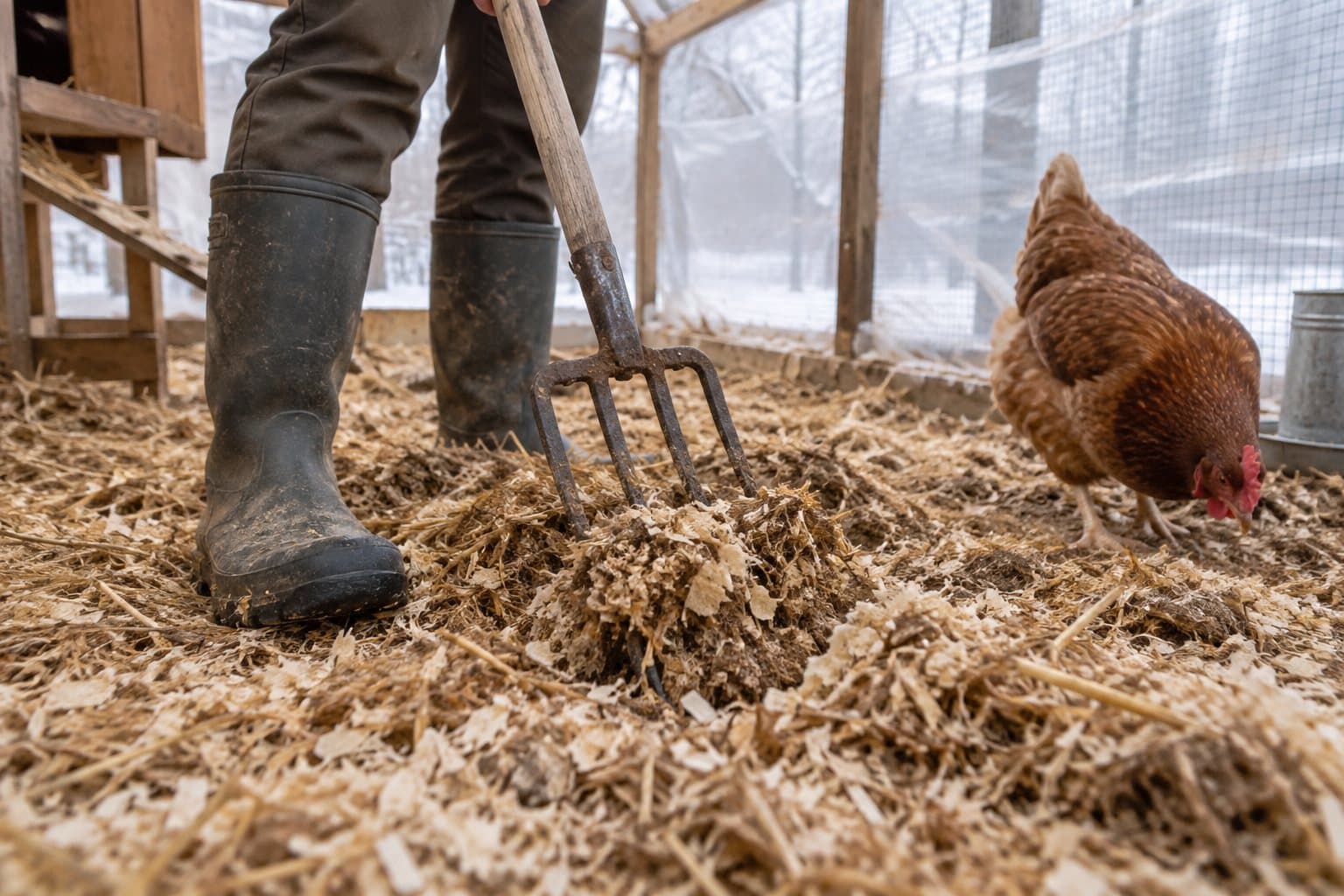
The sheet closes with storage advice: keep baled hay away from the animals, and keep hay and bedding stores away from anything that can burn. It also suggests asking your community about rules for animal housing and talking to the local fire department about any fire concerns. A spare bale of straw does not belong next to the outlet or under the heater.
 AI-generated
What the tip sheet does not say
Three popular claims go further than the sources do.
- A temperature for heat lamp bulbs and an ignition time for bedding. Figures circulate on blogs and in chatbot answers. We found no fire authority or laboratory that published them, so this site gives neither.
- A fire statistic for backyard coops. The tip sheet contains no numbers. Local reports exist; a national count for coops was not found.
- That a panel heater solves the problem. A manufacturer advertises its coop panel as safer than heat lamps. That comparison is fair. It does not remove the bedding, the dust or the birds from the equation, which is why the University of New Hampshire Extension still advises against heat in most circumstances.
A winter routine built from the twelve tips
Before winter
Have a qualified electrician install or check a fixed outlet at the coop, in a box designed to keep out dust and water. Check every cord for chew marks and cracks.When you set up a device
Mount heaters firmly and off the floor, hang or stand heated waterers clear of loose bedding, and plug each device into the fixed outlet with its own grounded cord. Follow the manufacturer's instructions for clearances.Every week
Brush dust, feathers and cobwebs from heaters, fixtures and outlets. Look at the cords while you are there.Every day
When you check the water, glance at each device: is it still where you mounted it, is the bedding still clear of it, does anything smell hot?After winter
Unplug and store heaters and heated waterers dry. A device that runs all summer collects dust for nothing.
Does your coop need the risk at all?
Every rule above manages a risk that starts with plugging something in. The extension services disagree on whether adult birds need heat, and all of them put a dry, draft-free, ventilated coop first. The two camps are laid out under do chickens need heat in the winter. Good chicken coop ventilation needs no electricity and adds no device to the coop.
Liquid water is the one winter need that often does call for a device. If you decide to heat the coop as well, how to heat a chicken coop walks through the order of work, and the overview of all heater types is on the chicken coop heater home page.
Questions keepers ask
What causes most chicken coop fires?
No national statistic for backyard coops was found. The clearest statement comes from the Maine Fire Marshal's Office, quoted by the Bangor Daily News: heat lamps, extension cords, bedding and water heaters are the four top causes, and heat lamps can be the most dangerous of the four. Three of the four are electrical devices, and the fourth is the fuel they sit next to.
Are heat lamps a fire hazard in a chicken coop?
Yes. The first two rules of the NFPA tip sheet deal with heat lamps: secure them properly so they cannot be knocked over, and keep them away from anything that can burn. The Maine Fire Marshal's Office explains why: chickens can knock a lamp into the bedding, and a cheap clamp is often not enough to hold it. The University of Maryland Extension adds that lamps can cause fires if they are not properly secured.
Can a heated chicken waterer start a fire?
It can. The Maine Fire Marshal's Office lists water heaters among the four top causes of coop fires, and Ohio State University Extension warns that heated water bowls or containers may malfunction and cause a fire. The NFPA tip sheet asks for care with electrically heated poultry waterers and for a properly grounded cord and plug. The University of Maryland Extension asks that a heated base cannot start a fire if it touches litter.
Is a radiant panel heater a fire risk too?
It is the lower-risk device compared with a heat lamp, not a risk-free one. A panel has no bulb, and it draws less power. The University of New Hampshire Extension still advises against supplemental heat in most circumstances, because combustible bedding is present and chickens tend to knock things over. A panel needs fixed mounting, a fixed outlet with ground-fault protection and regular removal of dust.
Should I keep a fire extinguisher near the chicken coop?
The NFPA tip sheet for backyard coops does not mention one. Penn State Extension, writing about barns in general, recommends ABC multi-purpose fire extinguishers within 50 feet of any point inside the barn and yearly inspection of wiring, junction boxes and panels. A backyard coop is far smaller than a barn, so this is a transfer, but an extinguisher within reach costs little effort.
Sources we read
- NFPA safety tip sheet: Backyard Chicken Coop Safety (copy published by the City of Kinston, NC)
- Bangor Daily News: heat lamps and coop fires, with University of Maine Cooperative Extension and the Maine Fire Marshal's Office
- University of New Hampshire Extension: How should I take care of backyard chickens in winter?
- University of Maryland Extension: Winter Weather and Small Flocks (FS-1133)
- Ohio State University Extension: Winter and Your Backyard Chickens (ANR-66)
- Penn State Extension: Fire Prevention in Barns
Keep reading
- Buying guideSafest coop heaterNo coop heater is risk-free. Which type carries the lowest documented risk, what the NFPA and extension services ask for, and which panel documents the most.
- ComparisonHeat lamp in the coopHeat lamps are named first among the top causes of coop fires. What the NFPA and extension services say, the rules if you use one, and the radiant panel instead.
- ExplainerPower for the coopThe NFPA says not to use extension cords in the coop. What a sound power supply for heaters and heated waterers looks like, and where manuals disagree.
- ExplainerDo chickens need heat?Do chickens need heat in the winter? Three extension services advise against it, one names 35 °F inside the coop, two say it depends. The sources side by side.
- How-toHow to heat a coopHeating a chicken coop in winter in the right order: decide with a thermometer, fix the coop, get fixed power, mount a low-wattage radiant panel, add a thermostat.
- ExplainerCoop ventilationChicken coop ventilation in winter: where vents go, how to tell ventilation from a draft, and the signs of too little air, based on six extension publications.
Who is behind this page
chickencoopheater.com Editorial Team
Coop heat, winter water and the sources behind both
We are the editorial team at chickencoopheater.com. We read what university extension services, the NFPA and manufacturers publish about heating a coop and keeping water liquid, and turn it into plain-English buying advice with the sources on every page.
- Extension and fire-safety sources named
- Manufacturer data and manuals compared
- Disagreements between sources shown
- Compared by manufacturer data