Skip to content
Chicken Coop Heater

Winter coop advice with the sources shown.

Menu

How-to

Deep Litter Method in the Chicken Coop: How It Works and How Much Heat to Expect

With the deep litter method you stop cleaning the coop out every few weeks in winter. You add fresh dry bedding on top instead, about an inch a week, and remove the whole layer in spring. The deep layer insulates the floor, and the University of Maryland Extension notes that it also generates heat as microbes break it down. No source puts a number on that heat. Expect a drier, better insulated floor, not a heated coop.

by the editorial team updated October 11, 2026 7 min read

The short version

Start with a few inches of dry pine shavings or straw. Through the winter, add about an inch of fresh bedding each week so that litter and manure stay at roughly half and half, stir packed spots, take out wet patches and keep the vents under the roof open. If the coop smells, add more bedding. Clean everything out in spring and compost it. The heat it gives off is mentioned by extension sources but not measured.
Jump to a section
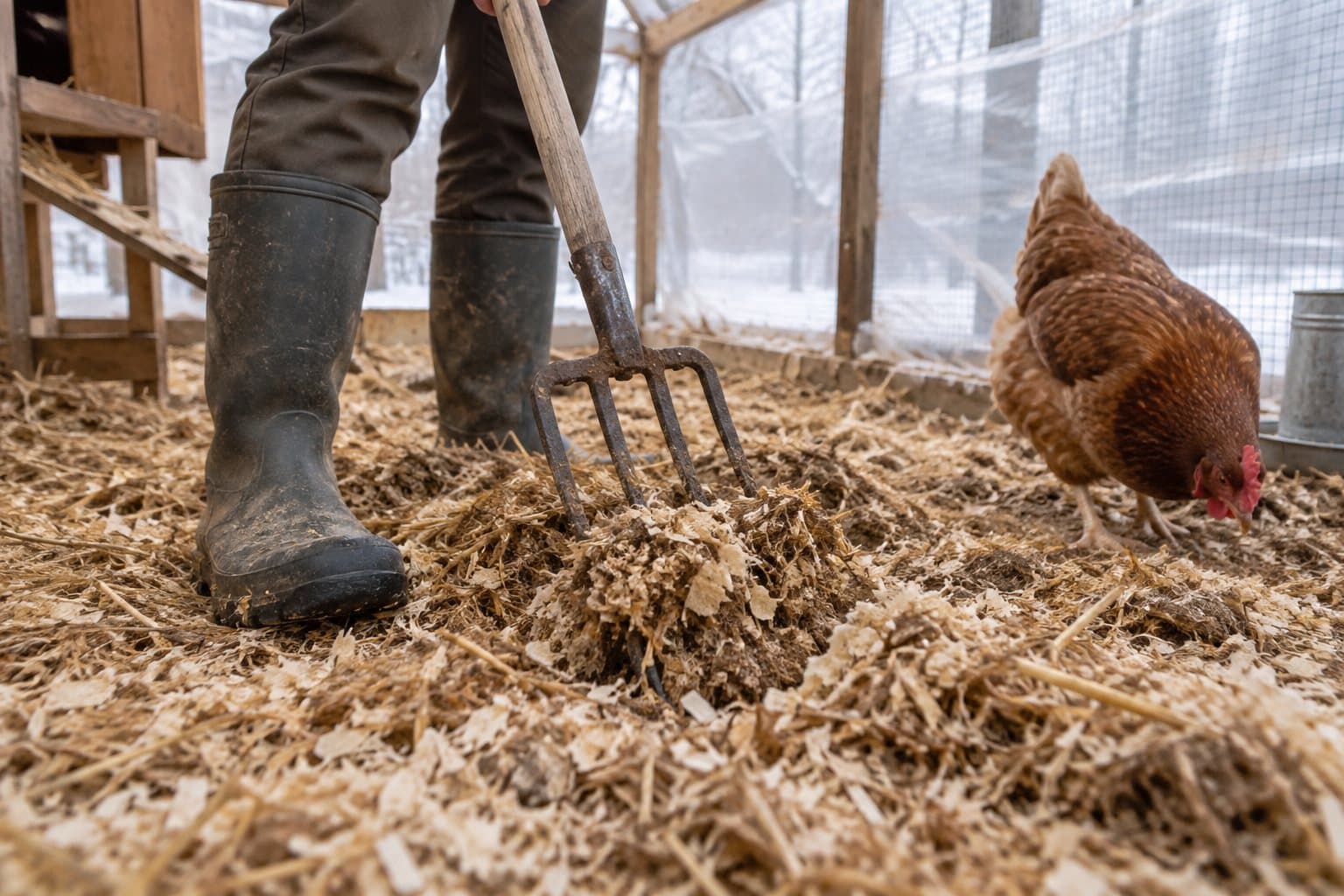
A garden fork turning a deep layer of dry bedding on a coop floor (AI-generated illustration)AI-generated

What you end up with, and how much work it is

The result is a coop floor covered by a thick, dry, loose layer that the birds scratch in all winter. The work is small and regular: fresh bedding once a week, a few minutes with a fork, a daily look. The big job moves to spring, when the whole layer comes out at once.

Deep litter is not a product and needs no power. It is one of the measures for keeping a chicken coop warm without electricity, and it only works together with the others: a dry coop, no drafts at roost height and open vents above the birds.

How much heat to expect

This is the claim that makes the method popular, so it deserves a precise answer.

SourceWhat it says about warmth
University of Maryland ExtensionDeep litter insulates the birds from the ground, and it also generates heat as it is broken down by microbial action
University of Wisconsin–Madison ExtensionA deep layer of bedding can help insulate the floor and may keep the coop slightly warmer
Ohio State University ExtensionBedding keeps the flock warm through an insulation effect
University of Vermont ExtensionThe weekly additions give the chickens dry footing and a composting environment beneath them

Two things stand out. Every source names insulation; only Maryland names heat from decomposition. And none of them gives a temperature, a number of degrees or a comparison with a heater. Figures of that kind circulate online, and we found no primary source for any of them.

So plan with what is documented. A deep, dry layer keeps the cold of the ground away from feet and from birds that come down off the roost. Whatever the composting adds comes on top and cannot be counted on. If you are deciding whether your flock needs a heater, deep litter does not settle that question; the positions of the extension services are laid out on the chicken coop heater home page and its linked pages.

What you need

  • Dry bedding. Pine shavings or straw are named most often (Maryland, New Hampshire); Ohio State also lists wood chips, soft hay, ground corn cobs and shredded paper
  • A fork or rake
  • A dry, roofed coop with vents under the roof
  • A place for a compost pile in spring

Step by step

  1. Clean out and start dry

    Ohio State University Extension advises removing all used bedding and cleaning the coop before adding a large quantity of new, dry bedding for the winter. For the first layer, University of Vermont Extension names 2 to 3 inches. Maryland calls 3 to 4 inches of pine shavings or straw good insulation, and New Hampshire suggests 4 to 6 inches where the coop floor is open to the ground.

  2. Add about an inch a week

    This is the step that turns ordinary bedding into deep litter. Outside of winter, Vermont removes the litter when litter and manure reach roughly half and half, about every two to four weeks. In winter it adds about an inch of bedding each week instead and keeps the same proportion. Spread the new material where the droppings collect, which is under the roost.

  3. Stir and fluff

    Ohio State notes that with more bedding the litter needs more attention, and advises stirring or fluffing it to keep the coop warm and dry. The area under the roost, where the droppings collect, is the place to start.

  4. Check moisture daily and remove wet patches

    Ohio State asks for a daily moisture check, because deep bedding can raise humidity in the coop. Wet litter does not stay in: Wisconsin says to remove it while dry bedding stays through the winter, and Penn State Extension gives the same rule for laying flocks. The usual wet spot is around the waterer. Ohio State also asks you to check waterers for leaks, since they add humidity.

  5. Keep the vents open

    A deep layer of composting bedding gives off moisture and ammonia. Both have to leave through openings above the birds. Ohio State warns that ammonia from litter in a tightly sealed coop can cause respiratory disease over time. How to ventilate without a draft on the roost is explained under chicken coop ventilation.

  6. Use your nose

    Vermont's rule is short: if the coop smells, add more bedding. A coop that still smells after that has a moisture or ventilation problem that more shavings will not solve.

  7. Clean out in spring and compost

    Vermont removes the litter when daytime temperatures are consistently above freezing, or sooner if the buildup gets in the way. The material then goes on a compost pile. Vermont describes a three-sided bin of about 3 by 3 by 3 feet, turned every one to two weeks and kept as moist as a squeezed-out sponge, and points out that raw litter can carry Salmonella and E. coli and needs about 120 days.

How deep in the end?

The depths in step 1 describe where to begin. Penn State Extension's figure of 3 to 4 inches is for ordinary litter in laying flocks that is replaced as needed. A final depth for a deep-litter coop is not named in any of the sources read for this page.

Where deep litter does not work

  • In a damp coop. A leaking roof or a floor that takes in water turns the layer into a wet mat. Fix the building first; the fall jobs are listed under winterizing a chicken coop.
  • In a sealed coop. Without vents, the moisture stays. Ohio State notes that humid air creates more frostbite risk than drier air, so a wet deep-litter coop can do more harm than a cold dry one. More on that under frostbite in chickens.
  • Where the layer blocks things. Several inches of litter raise the floor. Check that the pop door still opens, that feeders and waterers stay above the bedding and that the roost is still well off the floor.

Deep litter next to heaters and heated waterers

Bedding burns. If anything electrical is in the coop, a rising floor changes the clearances.

  • The University of New Hampshire Extension generally advises against supplemental heat because of the fire risk with combustible bedding.
  • A heated base for a waterer must not be able to start a fire on contact with litter (University of Maryland Extension). Keep it on a firm, raised, dry surface, not set into the bedding.
  • A heater that needs a stated clearance to bedding needs that clearance measured from the top of the litter in February, not from the bare floor in October.

The wider rules are collected under chicken coop fire safety.

Typical mistakes

  • Starting on old, damp bedding. The method begins with a clean, dry floor.
  • Adding bedding only when it looks bad. The weekly inch keeps the proportion of litter to manure right before the smell starts.
  • Closing the vents to keep the warmth in. That keeps the moisture in as well.
  • Forgetting grit. New Hampshire points out that birds may not find pebbles under insulating bedding and should be given grit.
  • Putting the spring cleanout straight on the garden. Raw manure can damage plants and carry pathogens (Vermont). Compost it first.

Where to go from here

Deep litter is one part of a winter coop. The daily routine around it is described under how to keep chickens warm in winter, and what insulation in walls and ceiling adds is covered under insulated chicken coops. If the coop is dry, deeply bedded and ventilated and the birds still show signs of cold, the low-wattage devices are compared under best chicken coop heaters.

Questions keepers ask

Does the deep litter method really heat a chicken coop?

It adds some warmth, and nobody has put a figure on it. The University of Maryland Extension writes that deep litter generates heat as it is broken down by microbial action. The University of Wisconsin–Madison Extension says a deep layer of bedding can help insulate the floor and may keep the coop slightly warmer. Neither gives degrees. Treat it as insulation with a small bonus, not as a heat source you can plan with.

How deep should deep litter be?

The sources name starting depths, not a final one. University of Vermont Extension starts with 2 to 3 inches and adds about an inch a week in winter. The University of Maryland Extension calls 3 to 4 inches of pine shavings or straw good insulation, and the University of New Hampshire Extension suggests 4 to 6 inches where the coop floor is open to the ground. The layer grows from there until the spring cleanout.

What is the best winter bedding for chickens?

Pine shavings and straw are the two materials the extension services name most often. Ohio State University Extension also lists wood chips, soft hay, ground corn cobs and shredded paper. Penn State Extension calls pine shavings the best choice and accepts any absorbent, low-dust material. Whatever you use has to go in dry and stay dry, because wet litter is what causes the trouble.

Does deep litter smell?

It should not. University of Vermont Extension gives a simple rule: if the coop smells, add more bedding. Smell means ammonia, and the University of Wisconsin–Madison Extension notes that wet litter produces ammonia that can harm chickens and irritate their keepers even at low levels. More dry bedding, removal of wet patches and open vents under the roof are the three answers the sources give.

When do you clean out deep litter?

In spring. University of Vermont Extension says to remove the litter when daytime temperatures are consistently above freezing, or earlier if the buildup becomes inconvenient. The University of Wisconsin–Madison Extension likewise says dry bedding can be left throughout the winter and cleaned out in spring, while wet litter comes out at once.

Sources we read

Keep reading

Who is behind this page

chickencoopheater.com Editorial Team

Coop heat, winter water and the sources behind both

We are the editorial team at chickencoopheater.com. We read what university extension services, the NFPA and manufacturers publish about heating a coop and keeping water liquid, and turn it into plain-English buying advice with the sources on every page.

  • Extension and fire-safety sources named
  • Manufacturer data and manuals compared
  • Disagreements between sources shown
  • Compared by manufacturer data

About us How we evaluate